|
As the conference is well documented, this feedback is brief and highly selective, with the aim of being most useful to researchers within ADM. The last Doctoral Education in Design conference was in Ohio in 1998, and like this event seemed to particularly attract those from theoretical disciplines, and from architectural or product design fields. Theoretical perspectives from fields including philosophy, anthropology, positivist science and language theory were presented. Delegates were mainly from North America, Australia, Northern Europe and the UK, with a scattering of speakers from Korea, Japan and Taiwan. Under a quarter of the participants were female. This particular combination of delegates seemed to produce a highly Cartesian aesthetic, despite the excellent French food! With a subtitle of "foundations for the future", the conference perhaps had a desire to establish the firmest bedrock upon which to proceed, but there was much disagreement about whose recipe for concrete may be the strongest. Some philosophers seemed convinced that their recipe was the best (even if only measured by the archaeological depth of their foundations), some with a positivist approach thought high-cement rigidity was the answer, whilst others wanted a more flexible reinforced aggregate approach which left space for the possibility that design research may develop its own methodology as well as borrowing from others. Perhaps the most promising thing to emerge at the end of the conference was the decision by the student volunteers present to develop a network for design and art research students, including a discussion list (to which supervisors are not invited!) Watch out for forthcoming news on the DRS list. In relation to 'practice-based' research, the conference was in an interesting condition. Prior to the conference there was hot debate on the DRS list, during which the quality and validity of some 'practice-led research' was questioned. The majority of the conference seemed unfamiliar with actual examples of such Ph.D.s, and may have been influenced by alarming suggestions that practice-based research might involve no writing, might involve no generalisability (although whether in a positivist or phenomenological sense wasn't clarified), or may just be about 'self-expression'. Speakers concerned with practice-based research thus tended to be asked to prove themselves innocent of these charges, even if their papers were about something else. Some in design seemed particularly anxious to differentiate themselves from artists (whose rampant 'subjectivity' may possibly taint the hard-won respectability of their research neighbourhood). On a more positive note, speakers from Robert Gordon University and Birmingham Institute of Art and Design spoke usefully about research training, acknowledging the difficulties of developing useful research methodologies. Chris Rust presented an argument for the articulate use of "rich but not dense" images as evidence and illustration within theses, but unfortunately the responses didn't develop much beyond the 'images are not words' argument. Some terminology was, however, usefully explored: 'practice-based' was rejected as a term by John Langrish, who saw research involving practice as an integral part of the research family, not needing a qualifier, and therefore just 'research'. Carole Gray foresaw a problem of trying to differentiate what her School understood by 'practice-based' from the ways in which the word has been picked up by other universities. My own view is that the qualifier 'practice-based' has been used perhaps as a short-term solution to the problem that without the qualifier, those in the arts would assume that an art Ph.D. is an art history or cultural theory Ph.D. Overall, the conference was perhaps most useful when exploring specific theoretical perspectives (such as behavioural anthropology). The long (four days) and linear (sequential presentations with no choices) approach may be an unusual one for contemporary conferences, but I found it a useful and productive change. The documentation was excellent (full papers in book form on arrival), and the environs pleasant, but the conference was rather let down by poor audiovisual equipment, and sometimes a rather poor reproduction of diagrams in the documentation. Some "Postcards from France" Following are a series of short comments from the conference, which you may want to follow up by reading the contributors' papers. Charles Owen presented a very useful overview (unfortunately not in the papers, though it will be in the book). He compared research aims and characteristics across a range of fields including science, law, medicine, design and art, and analysed them in terms of commitment to knowledge building and knowledge using within the areas of inquiry and application. Science, for example, showed more commitment to inquiry, whilst art, design and law showed more commitment to application. He described one process of using methodologies from other fields as "appropriate, subsume and declare". His conclusions were that:
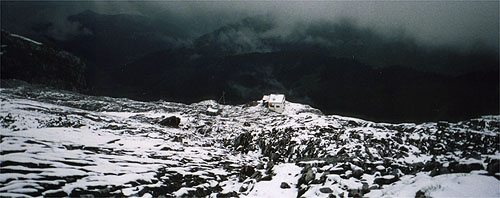
Harold Nelson and Erik Stolterman described design as "being in service" i.e. being a servant to the users and the clients. Kun-Pyo Lee described one model of the creation and consumption of design knowledge as a "rugby-style collaboration" (a scrum?) rather than a "relay race" (passed from one expert to another). Pelle Ehn and Carl Henrik Svenstedt described their research centre at Malmö University (involving real outside artists rather than the pet "house artist") as "an anxious act of political love." Despite being "in the over-50's department" they were some of the few presenters who seemed excited by research. John P. Shackleton and Kazuo Sugiyama presented a fascinating outline of Japanese doctoral degrees, and their paper points out that "sensei", a respectful term of address, is applied not only to academics, but to those who have a superior level of skill in any specialised area, particularly the traditional Japanese arts and crafts (DO read the paper). Christena Nippert-Eng is an anthropologist, and has worked with design students on observational method exercises (observing animals in a zoo). She noted that designers tend to be good on observing and notating space, but weak on time. Lorraine Justice described her experience of design research at Georgia Institute of Technology, Atlanta, and of particular interest was their new approach to research training. They decided to drop some computer skills training in favour of more methodology training. Related to this issue might also be Ken Friedman's comment that some universities are "training mechanicals and calling them designers". In the UK there has been much debate in art and design education (graduate and post-grad) about whether the difficulties of teaching new software and technical skills may be detracting from the less 'vocational' aspects of education, and from broader skills. These issues could also apply to research education. Norman Sheehan made several good-humoured and gentle interventions which (hopefully) deeply challenged many assumptions made by the participants. In particular, his work with Aboriginal Australian artists and researchers, and the complex debate regarding the positioning of aboriginal 'art' as 'art object' or as 'cultural knowledge'. He was also one of the few to consciously explore some of the power relationships between the 'rational empirical' and the 'relational emotive'. Michael Biggs' playful definition of objectivity was 'that which people don't object to'! He has written usefully about objectivity in art and design research (see Research Into Practice conference). Jan Verwijnen called for an end to "Schön-abuse" (people referring to Donald Schön's The Reflective Practitioner in the wrong context). He suggests that Schon's work should be read more carefully. --- And the snaps? I went walking for 4 days after the conference, and stayed in mountain refuges. Apparently, raining every day for ten days, and having snow this low, is very unusual for July. However, warm welcomes, mulled wine and nine (very polite) members of the French army enabled us to solve the educational, military and gender problems of Europe despite my French vocabulary of about 100 words. I'm considering Refuge de Gramusset as a future conference venue. Below: Refuge de Gramusset (2160m). I stayed there 15th July. Beryl Graham, August 2000
|